
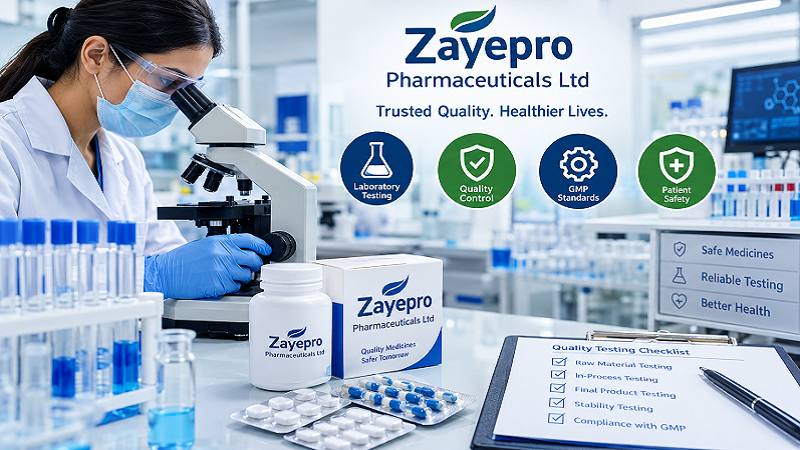
In the pharmaceutical industry, medicine quality and patient safety are essential priorities. Every medicine must meet appropriate quality requirements to ensure that it contains the correct ingredients, maintains its intended strength, and meets established safety standards. As consumers become more conscious of healthcare quality, searches for zayepro pharmaceuticals ltd tested reflect an interest in pharmaceutical verification, laboratory procedures, and the reliability of medicines associated with this company.
Understanding pharmaceutical testing requires more than knowing whether a product has been tested. It involves examining manufacturing practices, laboratory results, regulatory authorization, product labeling, and quality assurance procedures. These factors help healthcare professionals and consumers make informed decisions about pharmaceutical products.
We will explore how pharmaceutical testing works, which standards are commonly applied, how consumers can verify medicine quality, and what information should be confirmed before trusting a pharmaceutical product.
What Does Zayepro Pharmaceuticals Ltd Tested Mean?
The phrase zayepro pharmaceuticals ltd tested can refer to searches for information about the testing, quality verification, and safety of pharmaceutical products associated with Zayepro Pharmaceuticals Ltd. However, the phrase alone does not establish that a particular medicine has undergone laboratory testing or received regulatory approval.
To determine whether a pharmaceutical product has been properly evaluated, we need verifiable evidence. This may include official registration information, product-specific quality documentation, manufacturing details, and laboratory reports from appropriately qualified facilities.
Pharmaceutical testing generally involves examining a medicine’s composition, strength, purity, stability, and other characteristics relevant to its intended use. The precise tests depend on the product, its ingredients, dosage form, manufacturing process, and applicable regulations.
For example, a tablet may require testing for active ingredient content, dissolution, uniformity, and impurities. An injectable medicine may require additional sterility and bacterial endotoxin testing. These requirements demonstrate why pharmaceutical verification must be specific to the product rather than based solely on a company’s name.
Understanding Pharmaceutical Quality Control
Quality control is a fundamental part of pharmaceutical manufacturing. It helps manufacturers determine whether raw materials, production processes, and finished products meet established specifications.
A comprehensive quality control system typically includes several stages.
1. Raw Material Testing
Before manufacturing begins, pharmaceutical ingredients must be evaluated against appropriate specifications. Testing may establish the identity, purity, strength, and quality of active pharmaceutical ingredients and other materials.
Manufacturers also assess suppliers, review documentation, and examine whether incoming materials meet the required standards. Depending on the material and applicable regulations, additional testing may be necessary to identify contaminants or confirm specific properties.
Proper raw material verification helps prevent unsuitable ingredients from entering the production process.
2. In-Process Quality Checks
Quality assurance does not stop after ingredients have been approved. During manufacturing, trained personnel monitor critical production parameters and verify that processes remain within established limits.
For tablets, these checks may include weight variation, hardness, moisture content, and production consistency. Liquid medicines may require checks involving concentration, pH, appearance, or mixing uniformity.
The exact procedures depend on the formulation and manufacturing method. Identifying problems during production helps reduce the risk of defects in the finished product.
3. Finished Product Testing
Finished product testing determines whether a medicine meets its approved specifications before release. Depending on the product, laboratory assessments may examine identity, potency, purity, impurities, dissolution, physical characteristics, and microbiological quality.
A batch should not be considered acceptable merely because it looks normal or carries professional packaging. Appropriate testing, documentation, and authorized quality review are necessary to support a product’s release.
4. Stability Testing
Stability testing evaluates how a medicine’s quality changes over time under specified storage conditions. It helps establish or support the product’s shelf life, storage instructions, and expiration date.
Temperature, humidity, light, and packaging can affect the stability of certain pharmaceutical products. Stability studies help determine whether a medicine continues to meet its required specifications throughout its intended storage period.
Common Laboratory Tests Used in Pharmaceutical Manufacturing
Pharmaceutical testing involves different scientific methods. No single test can establish every aspect of a medicine’s quality.

| Test category | What it evaluates | Why it matters |
|---|---|---|
| Identity testing | Whether the expected ingredient is present | Helps prevent ingredient substitution or identification errors |
| Assay testing | The amount or concentration of an active ingredient | Verifies compliance with strength specifications |
| Impurity testing | Unwanted chemical substances | Helps assess chemical purity and potential risks |
| Dissolution testing | How an ingredient is released from a dosage form | Helps evaluate product performance where applicable |
| Uniformity testing | Consistency between individual dosage units | Helps ensure appropriate dose distribution |
| Microbiological testing | Relevant microorganisms or contamination | Supports microbiological quality requirements |
| Stability testing | Changes during storage | Helps establish shelf life and storage conditions |
These tests are selected according to the medicine’s formulation, intended route of administration, and relevant quality standards. A product does not necessarily require every test listed above, and the presence of a test report does not automatically demonstrate compliance with all applicable requirements.
Good Manufacturing Practices and Pharmaceutical Safety
Good Manufacturing Practices (GMP) provide a framework for manufacturing medicines consistently and controlling risks that could affect product quality. They address much more than laboratory testing.
GMP systems generally cover personnel training, equipment maintenance, sanitation, production controls, documentation, quality management, and the handling of deviations. They also establish procedures for investigating manufacturing problems and preventing their recurrence.
Documentation and Batch Traceability
Reliable pharmaceutical manufacturing depends on accurate records. Batch documentation helps establish which materials were used, how production was performed, which tests were conducted, and whether the finished product met its specifications.
Traceability also supports investigations when a quality problem occurs. If a defect is identified, appropriate records can help determine which batches may be affected and whether corrective action is necessary.
Contamination Prevention
Contamination can occur through unsuitable materials, equipment, personnel, environmental conditions, or inadequate production controls. Pharmaceutical manufacturers use appropriate cleaning procedures, environmental monitoring, and process controls to manage these risks.
Sterile products require particularly stringent controls because contamination can pose serious health risks. The appropriate controls depend on the product and its manufacturing environment.
Quality Assurance and Product Release
Quality assurance oversees the broader system used to maintain pharmaceutical standards. It reviews procedures, records, investigations, and other evidence needed to determine whether manufacturing and testing requirements have been satisfied.
For consumers researching zayepro pharmaceuticals ltd tested, it is important to distinguish general information about pharmaceutical quality systems from independently verified information about a specific company or product.
How to Verify Zayepro Pharmaceuticals Ltd and Its Products
When researching a pharmaceutical company, we should prioritize verifiable records rather than unsupported online statements. The following steps can help establish whether a product is appropriately documented.
Check Official Company Information
Look for the company’s complete legal name, registered address, official contact information, and manufacturing or distribution details. Compare these details with information provided by relevant government authorities or official business registries.
A professional-looking website does not independently establish that a company is licensed to manufacture or distribute medicines.
Verify Product Registration
Check whether the specific medicine is authorized by the relevant national medicines regulator. Registration requirements vary by country, product category, and intended use.
In Pakistan, the Drug Regulatory Authority of Pakistan (DRAP) is an important official source for information about regulated therapeutic products and pharmaceutical oversight. Relevant official records can help establish whether a product or manufacturer has the required authorization.
The exact product name, manufacturer, registration details, and dosage form should match the information in the official record.
Review Laboratory Documentation
Where testing documentation is available, examine the identity of the tested product, batch number, testing date, methods used, specifications, and reported results.
A useful report should clearly identify the sample and the tests performed. When appropriate, the laboratory’s qualifications and accreditation status should also be checked.
A general statement such as “laboratory tested” is not equivalent to a complete, independently verifiable report.
Examine Packaging and Labeling
Packaging can provide important information about a medicine’s identity and traceability. Depending on the product and local requirements, relevant details may include:
- Product name and dosage strength.
- Active ingredients and dosage form.
- Manufacturer or marketing authorization holder.
- Batch or lot number.
- Manufacturing and expiration dates.
- Storage instructions and required warnings.
- Registration or authorization details where applicable.
Missing, inconsistent, altered, or illegible information should be treated as a reason to seek professional verification.
Consult a Pharmacist or Healthcare Professional
Pharmacists and other qualified healthcare professionals can help determine whether a medicine is appropriate, whether its labeling appears consistent with authorized product information, and where relevant registration details can be checked.
Consumers should not rely on search results alone when deciding whether to take an unfamiliar medicine.
Why Pharmaceutical Testing Matters for Patients
Pharmaceutical testing helps protect patients by identifying quality problems before medicines reach the market. It also supports consistent manufacturing and provides evidence that products meet established specifications.
Correct Strength and Composition
A medicine must contain the intended active ingredient in the appropriate amount. Testing helps identify products that contain too little, too much, or an incorrect ingredient.
Such problems can affect treatment outcomes and may expose patients to avoidable risks.
Control of Impurities
Chemical impurities can originate from raw materials, manufacturing reactions, degradation, or other sources. Their presence and acceptable limits depend on the substance and product.
Validated analytical methods help manufacturers identify and measure relevant impurities so that the product can be assessed against appropriate specifications.
Consistent Product Performance
Medicines must perform as intended when used according to their approved instructions. Depending on the dosage form, quality testing can help assess dissolution, uniformity, stability, and other relevant characteristics.
These evaluations support product consistency, although laboratory compliance alone cannot guarantee an individual’s treatment outcome.
Protection Against Substandard and Falsified Medicines
Substandard medicines fail to meet applicable quality specifications, while falsified medicines deliberately misrepresent their identity, composition, or source.
Checking product authorization, packaging, traceability, and supply-chain reliability can help reduce the risk of encountering unsafe products.
The Role of International Pharmaceutical Standards
Pharmaceutical quality systems operate within national regulatory frameworks and internationally recognized scientific principles.
The World Health Organization (WHO) publishes guidance concerning pharmaceutical quality assurance, good manufacturing practices, and the regulation of medical products. The International Council for Harmonisation (ICH) also develops guidelines covering areas such as pharmaceutical quality, stability, impurities, and analytical procedures.
These guidelines help promote consistent scientific approaches across participating regulatory systems. However, their application depends on the relevant jurisdiction, product category, and regulatory requirements.
A company should not be assumed to comply with a particular international standard simply because the standard is widely recognized. Compliance must be supported by appropriate documentation, inspections, certifications, or other relevant evidence.
Research and Development in Pharmaceutical Testing
Research and development supports improvements in pharmaceutical formulations, analytical methods, manufacturing processes, and product performance.
Scientists may investigate how active ingredients interact with other substances, how environmental conditions affect stability, or how testing methods can detect smaller quantities of impurities.
Analytical techniques such as high-performance liquid chromatography, gas chromatography, and spectroscopy can help identify or quantify chemical substances. Microbiological methods provide additional information when microbial quality is relevant.
Method validation is also important. It helps establish whether an analytical procedure is suitable for its intended purpose, considering characteristics such as accuracy, precision, specificity, and sensitivity.
Research can improve the reliability of testing, but new methods must be evaluated and implemented appropriately before they can support regulated quality decisions.
Emerging Technologies in Pharmaceutical Quality Assurance
Technology is changing how pharmaceutical manufacturers collect, review, and interpret quality information.
Automation and Digital Records
Automated laboratory equipment can improve consistency and reduce some forms of manual error. Electronic records can also make it easier to review results, maintain traceability, and investigate deviations when systems are properly designed and controlled.
Automation does not eliminate the need for trained personnel, equipment qualification, method validation, and independent quality oversight.
Artificial Intelligence and Data Analysis
Artificial intelligence may help researchers identify unusual patterns, assess large datasets, and improve certain analytical workflows. It can also support predictive maintenance and the investigation of process variations.
However, AI-generated findings are not a substitute for validated testing or regulatory authorization. Pharmaceutical decisions require reliable evidence and appropriate human oversight.
Continuous Manufacturing and Process Monitoring
Some pharmaceutical operations use continuous manufacturing and advanced process monitoring to assess quality throughout production. These approaches can provide timely information about critical manufacturing parameters.
Their suitability depends on the product, process design, regulatory expectations, and the manufacturer’s ability to demonstrate reliable control.
Common Misunderstandings About Tested Pharmaceutical Products
Several misconceptions can make it difficult for consumers to evaluate pharmaceutical claims accurately.
Misunderstanding 1: Every tested medicine is automatically safe. Testing reduces uncertainty and helps identify quality problems, but it cannot eliminate every risk. Medicines can cause side effects, interact with other substances, or be unsuitable for particular patients.
Misunderstanding 2: A company website proves regulatory approval. Company-published information can be useful, but official regulatory records and verifiable documentation provide stronger evidence of authorization.
Misunderstanding 3: GMP certification proves every product is effective. GMP concerns manufacturing quality and control. Evidence of a medicine’s effectiveness and authorization depends on the applicable regulatory requirements and supporting product-specific data.
Misunderstanding 4: All pharmaceutical products require identical tests. Testing requirements vary according to ingredients, formulation, route of administration, and intended use.
Misunderstanding 5: Online reviews confirm medicine quality. Reviews may describe customer experiences, but they cannot replace laboratory reports, regulatory records, or professional medical advice.
Frequently Asked Questions About Zayepro Pharmaceuticals Ltd Tested
What does Zayepro Pharmaceuticals Ltd Tested mean?
The phrase generally reflects a search for information about pharmaceutical testing and product quality associated with Zayepro Pharmaceuticals Ltd. It does not, by itself, confirm that a specific product has passed laboratory tests or received regulatory approval.
How can we determine whether a medicine has been tested?
We can review product-specific laboratory documentation, relevant regulatory records, batch information, and manufacturer details. A qualified pharmacist or healthcare professional can help identify appropriate verification sources.
Does laboratory testing guarantee that a medicine is safe?
No. Testing provides important evidence about product quality, but safety also depends on proper manufacturing, regulatory assessment, storage, prescribing, and correct use. No medicine is entirely free from risk.
What is the difference between quality testing and regulatory approval?
Quality testing evaluates whether a product meets specified requirements. Regulatory approval or authorization is a separate process governed by the relevant authority and may involve reviewing quality, safety, effectiveness, and other required evidence.
Where can we check pharmaceutical registration in Pakistan?
DRAP is an important official starting point for checking relevant pharmaceutical registration and regulatory information. Consumers should verify that the product and manufacturer details match the applicable official records.
Should we use a medicine if its testing status is unclear?
We should not assume that an unfamiliar medicine is reliable when its identity, authorization, or source cannot be verified. A pharmacist or qualified healthcare professional can advise on appropriate next steps.
Conclusion
Understanding zayepro pharmaceuticals ltd tested requires a careful distinction between general pharmaceutical testing principles and verified claims about a particular company or medicine. Quality control, laboratory analysis, Good Manufacturing Practices, stability studies, and regulatory oversight all contribute to pharmaceutical reliability.
We can make more informed decisions by checking official company information, confirming product registration, reviewing credible laboratory documentation, and seeking advice from qualified healthcare professionals. Packaging, online claims, and general statements about testing should never be treated as conclusive proof of product quality.
Ultimately, trustworthy pharmaceutical information must be supported by verifiable evidence. Careful verification helps consumers distinguish documented quality standards from unconfirmed claims and supports safer, more informed healthcare decisions.